MEDESSA · ODESA
Transabdominal pelvic ultrasound (uterus and adnexa)
A transabdominal pelvic scan is performed over the lower abdomen. It gives an overview of the uterus and adnexa and can be used when an internal scan is unsuitable.
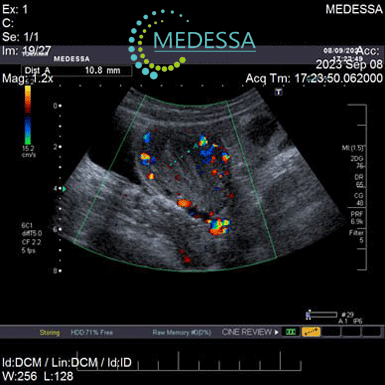
What the scan can show
The scan can help assess pelvic pain, pressure or larger findings such as fibroids and ovarian cysts. Bowel gas and the position of pelvic organs may obscure smaller details.
Why both approaches are sometimes used
Scanning through the abdomen gives a wider view and can help assess a large mass that extends beyond the pelvis. A transvaginal scan can show the lining of the uterus and the ovaries in more detail. If pain or bleeding remains unexplained, symptoms and clinical findings guide the next step. Tell the clinician before the scan if pregnancy is possible.
Pain and bleeding when pregnancy is possible
If pregnancy is possible and you have pain or bleeding, a clinician may request a pregnancy test, a blood test for hCG and ultrasound. Early in pregnancy, a scan through the abdomen alone may be unable to show where the pregnancy is located. Severe pain, weakness, dizziness or fainting needs emergency assessment.
Preparation and what to expect
A full bladder is usually needed. Ask the clinic how much to drink and when. The clinician applies gel and moves the probe across the lower abdomen.
When further tests can help
With your consent, a transvaginal scan may provide a closer view. MRI is useful for selected questions, such as clarifying a complex mass when ultrasound images are inconclusive.
Results and next steps
Bring earlier reports for comparison. Sudden severe pain or bleeding with dizziness requires urgent assessment.
Frequently asked questions
Why is a full bladder helpful?
Fluid provides an acoustic window and helps move bowel away. Ask the clinic for drinking instructions.
Is the probe inserted?
For this approach the probe moves across the skin. An internal scan, if useful, is discussed separately.
What if my bladder feels too full?
Tell the staff. They can advise whether you may partially empty it or adjust preparation.
Why might an ovary be hard to see?
Its position and bowel gas can affect visibility. The clinician can decide whether another approach is useful.
Can ultrasound show fibroids?
It can show fibroids. Their location and visibility affect how precisely they can be described.
Do external and internal scans show the same detail?
An external scan offers an overview. An internal probe sits closer to the organs and can reveal smaller details.
Does the scan use radiation?
The images are made using sound waves. Ultrasound does not use ionising radiation.
Will I need a contrast injection?
The standard scan described here does not usually require contrast. Check the separate instructions if another test has been ordered.
Can I resume my usual activities afterwards?
Routine diagnostic ultrasound generally requires no recovery. A separate procedure may have its own aftercare instructions.
Who decides what happens after the report?
Review it with the clinician who requested the scan. They can interpret the findings alongside your symptoms and other test results.
Medical sources and guidelines
Last updated:
Transabdominal pelvic ultrasound (uterus and adnexa): 800 ₴
This article is for information only.