MEDESSA · ODESA
Transvaginal pelvic ultrasound (uterus and adnexa)
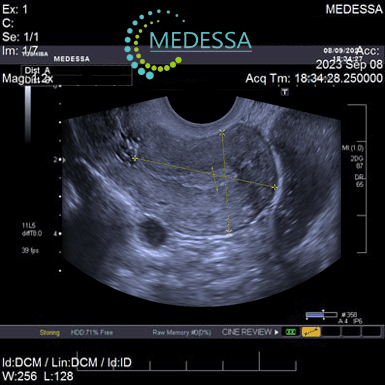
A transvaginal scan brings the probe close to the pelvic organs, giving a detailed view of the uterus, uterine lining and ovaries.
What the scan can show
Your clinician may recommend it for pelvic pain, unusual bleeding or follow-up of an ovarian cyst. The scan can assess fibroids, the thickness of the uterine lining and the features of an ovarian mass. Age, menstrual cycle and symptoms all matter when interpreting the findings.
Bleeding and assessment of the uterine lining
With unusual bleeding, the scan can assess the uterine lining and may show signs of a polyp or a fibroid beneath it. Lining thickness is interpreted in the context of age, cycle timing and menopause. Tell your gynaecologist about even light bleeding after menopause. Recurrent bleeding may need further assessment, including hysteroscopy or tissue sampling when indicated.
Preparation and what to expect
With your consent, the clinician gently inserts a slim, covered probe with lubricating gel into the vagina. An empty bladder is usually requested. You can ask for a pause or stop at any point. If an internal exam is unsuitable, ask about an abdominal approach.
When further tests can help
Pelvic MRI can help map deep endometriosis or clarify an uncertain mass on ultrasound. A normal scan cannot rule out superficial endometriosis.
Results and next steps
Discuss the report with your gynaecologist. Seek urgent care for sudden severe pain, fainting or heavy bleeding, particularly if pregnancy is possible.
Frequently asked questions
Do I need a full bladder?
Usually you empty it for the internal scan. Ask which scan comes first if both approaches are planned.
Can I pause the examination?
Yes. Tell the clinician if you feel discomfort. You can ask to pause or stop.
Does cycle timing matter?
That depends on what the scan is for. Tell the clinic when your last period started and what symptoms you have.
Does a normal scan rule out endometriosis?
Superficial disease may be invisible on imaging. Discuss next steps with your gynaecologist if symptoms persist.
Are the fallopian tubes always visible?
Normal tubes often cannot be seen. This alone does not explain symptoms.
Can I decline an internal scan?
Yes. Ask about an external scan and what it can show for your particular symptoms.
Does the scan use radiation?
The images are made using sound waves. Ultrasound does not use ionising radiation.
Will I need a contrast injection?
The standard scan described here does not usually require contrast. Check the separate instructions if another test has been ordered.
Can I resume my usual activities afterwards?
Routine diagnostic ultrasound generally requires no recovery. A separate procedure may have its own aftercare instructions.
Who decides what happens after the report?
Review it with the clinician who requested the scan. They can interpret the findings alongside your symptoms and other test results.
Medical sources and guidelines
Last updated:
Transvaginal pelvic ultrasound (uterus and adnexa): 800 ₴
This article is for information only.