MEDESSA · ODESA
Urinary tract ultrasound (kidneys and bladder)
The scan assesses the kidneys and bladder. It may be requested for flank pain, abnormal urine tests or difficulty urinating.
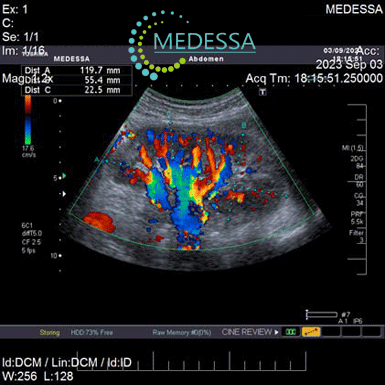
What the scan can show
The clinician looks at kidney size, dilation of the collecting system and visible masses. Post-void residual urine can be measured when requested. Small ureteric stones and some causes of blood in the urine may be missed.
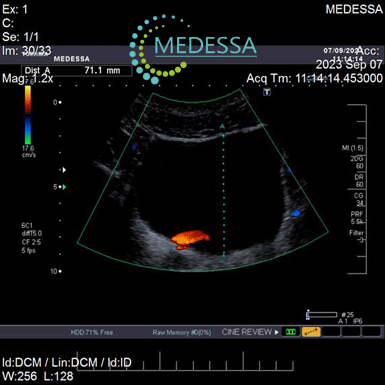
A dilated collecting system or a kidney cyst
A dilated renal pelvis can suggest impaired urine drainage. The finding alone does not always show what caused it or where a blockage is. A confidently identified simple cyst usually needs no further imaging. A lesion with an atypical appearance may need a dedicated examination.
When urine and blood tests add information
Ultrasound can show dilation of the urinary tract and some structural changes. Urine tests can look for blood or signs of infection, while creatinine helps assess kidney function. If blood in the urine is confirmed, age, other risk factors and test results guide further assessment. Ultrasound alone may leave the cause unresolved.
Preparation and what to expect
A probe is moved over the abdomen and sides. An adequately filled bladder is usually needed for bladder imaging. Ask how much and when to drink, particularly if you have a fluid restriction.
When further tests can help
Dedicated renal MRI can clarify the structure and enhancement of an indeterminate kidney mass. Non-contrast CT may be chosen for a suspected stone. Blood in the urine can require a different work-up, including cystoscopy when indicated.
Results and next steps
Severe pain with fever or inability to pass urine needs urgent assessment. Bring the report and earlier test results to your appointment.
Frequently asked questions
What is post-void residual urine?
It is the urine left in the bladder after you pass urine. A repeat scan after emptying the bladder measures it.
Can ultrasound find every stone?
Small ureteric stones may be missed. Your symptoms help guide further testing.
Does this measure kidney function?
Kidney function is assessed with tests such as blood creatinine. Ultrasound primarily shows anatomy.
What if I have a fluid restriction?
Tell the clinic when booking. Bladder preparation should take your fluid limit into account.
Does a normal scan explain blood in urine?
It can leave the cause unresolved. Tell your clinician about the symptom even if the scan is normal.
What does collecting system dilation mean?
Your clinician interprets this finding alongside your symptoms. Further tests may be needed to look for a blockage.
Does the scan use radiation?
The images are made using sound waves. Ultrasound does not use ionising radiation.
Will I need a contrast injection?
The standard scan described here does not usually require contrast. Check the separate instructions if another test has been ordered.
Can I resume my usual activities afterwards?
Routine diagnostic ultrasound generally requires no recovery. A separate procedure may have its own aftercare instructions.
Who decides what happens after the report?
Review it with the clinician who requested the scan. They can interpret the findings alongside your symptoms and other test results.
Medical sources and guidelines
Last updated:
Urinary tract ultrasound (kidneys and bladder): 800 ₴
This article is for information only.